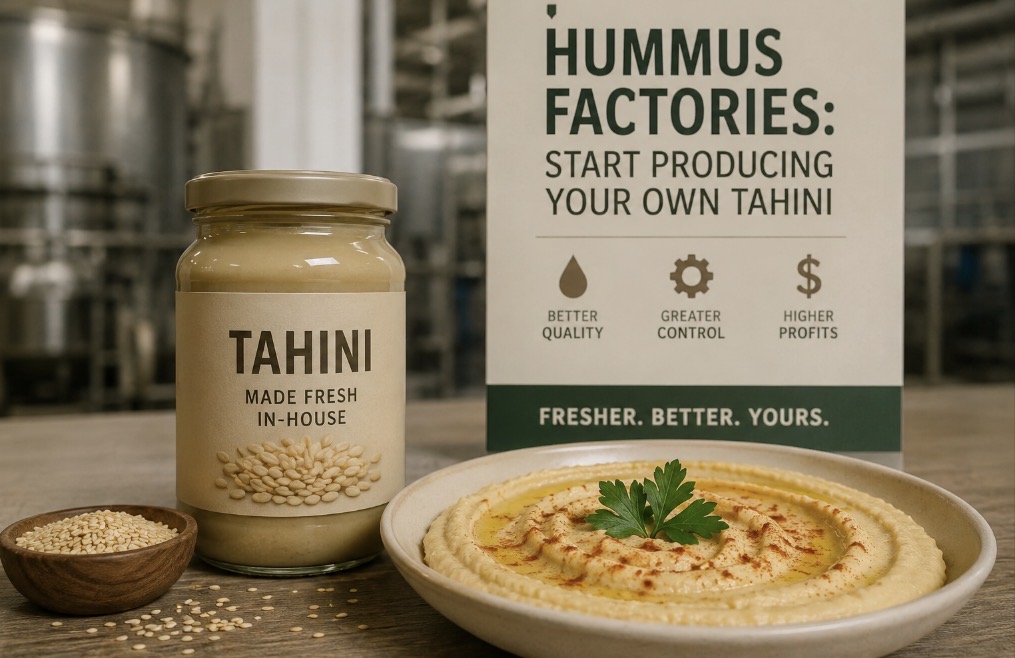
Why Tahini Is the Real Cost Driver in Hummus Production — And Why Making It In-House Can Save Your Factory Thousands
For most hummus manufacturers, chickpeas get all the attention. They are the base ingredient, the foundation of the product, and the ingredient customers recognize first. But inside the factory, the real budget pressure often comes from somewhere else entirely: tahini.
Tahini is the single most expensive ingredient in many commercial hummus recipes, and for growing manufacturers, it can quietly consume margins month after month. The good news is that there is a practical solution. Producing tahini in-house can dramatically reduce production costs, improve quality control, and create long-term financial stability for hummus businesses.
Tahini: The Hidden Expense in Every Batch
A standard commercial hummus formula is relatively simple:
- Chickpeas
- Tahini
- Oil
- Lemon juice
- Salt and seasoning
Among these ingredients, tahini typically carries the highest cost per kilogram. Sesame seeds are globally traded commodities with fluctuating prices affected by weather, shipping costs, crop yields, and international demand. Once tahini is processed, packaged, transported, and sold through suppliers, the markup increases even more.
For many hummus factories, purchased tahini can represent:
- 35–50% of total ingredient costs
- One of the largest sources of price volatility
- A major factor reducing profit margins
Even a small increase in tahini prices can significantly impact profitability when producing hummus at scale.
The Problem With Buying Tahini From Suppliers
Outsourcing tahini production may seem convenient, but it introduces several hidden costs:
1. Supplier Markups
Commercial tahini suppliers build in margins for:
- Processing
- Packaging
- Transportation
- Storage
- Distribution
- Broker fees
Your factory ultimately pays for every layer in the supply chain.
2. Inconsistent Quality
Tahini quality can vary from shipment to shipment depending on:
- Sesame origin
- Roasting level
- Oil content
- Grinding consistency
This inconsistency affects the flavor, texture, and shelf stability of hummus.
3. Supply Chain Risks
Global shipping disruptions and sesame shortages can quickly lead to:
- Delayed production
- Increased prices
- Contract instability
- Emergency sourcing at premium costs
For factories operating on tight schedules, tahini shortages can become operational nightmares.
Why In-House Tahini Production Changes Everything
Producing tahini internally gives hummus manufacturers direct control over one of their biggest expenses.
Instead of buying finished tahini, factories purchase raw sesame seeds and process them on-site. This single operational shift can produce major savings.
Lower Cost Per Kilogram
Raw sesame seeds are significantly cheaper than finished tahini. By removing external supplier margins, factories can reduce tahini costs substantially.
For medium and large-scale producers, the savings compound quickly across thousands of kilograms of weekly production.
Better Margin Protection
In-house production helps stabilize costs because businesses are less exposed to:
- Supplier price increases
- Packaging markups
- Freight fluctuations
This creates more predictable budgeting and pricing.
Improved Product Consistency
Factories gain full control over:
- Roasting temperature
- Grinding texture
- Oil separation
- Flavor profile
That means more consistent hummus quality and stronger brand reliability.
Faster Production Flexibility
When tahini is produced on-site, manufacturers can:
- Adjust recipes quickly
- Respond faster to demand spikes
- Reduce storage dependence
- Minimize delays caused by supplier lead times
The Financial Impact Can Be Massive
Consider a factory producing several tons of hummus per week.
Even reducing tahini costs by a modest percentage can translate into:
- Tens of thousands saved annually
- Improved gross margins
- More competitive pricing
- Higher profitability per unit sold
For high-volume operations, the return on investment for tahini equipment can happen surprisingly fast.
What Equipment Is Needed?
Modern tahini production systems are more accessible than many manufacturers realize. A basic production setup may include:
- Sesame cleaning systems
- Roasting machines
- Cooling conveyors
- Grinding mills
- Mixing and storage tanks
Depending on production scale, systems can be semi-automatic or fully automated.
Many factories start with partial in-house production before expanding capacity as savings increase.
In-House Tahini Is More Than a Cost Strategy
While cost reduction is the biggest driver, producing tahini internally also strengthens operational independence.
Manufacturers gain:
- Better inventory control
- Stronger negotiating power
- Product customization opportunities
- Reduced reliance on third-party suppliers
In a competitive hummus market where margins are constantly under pressure, these advantages matter.
Final Thoughts
For hummus factories looking to improve profitability, tahini deserves far more attention than it usually receives. It is often the largest ingredient expense, the biggest source of pricing instability, and one of the easiest opportunities for long-term savings.
Making tahini in-house is not just a production upgrade — it is a strategic financial decision. By controlling tahini production internally, hummus manufacturers can reduce costs, improve consistency, and build a more resilient business for the future.